The Queer Shepherds Preserving Navajo Tradition
This rare breed has almost gone extinct twice. Thanks to these young shepherds, it lives on.
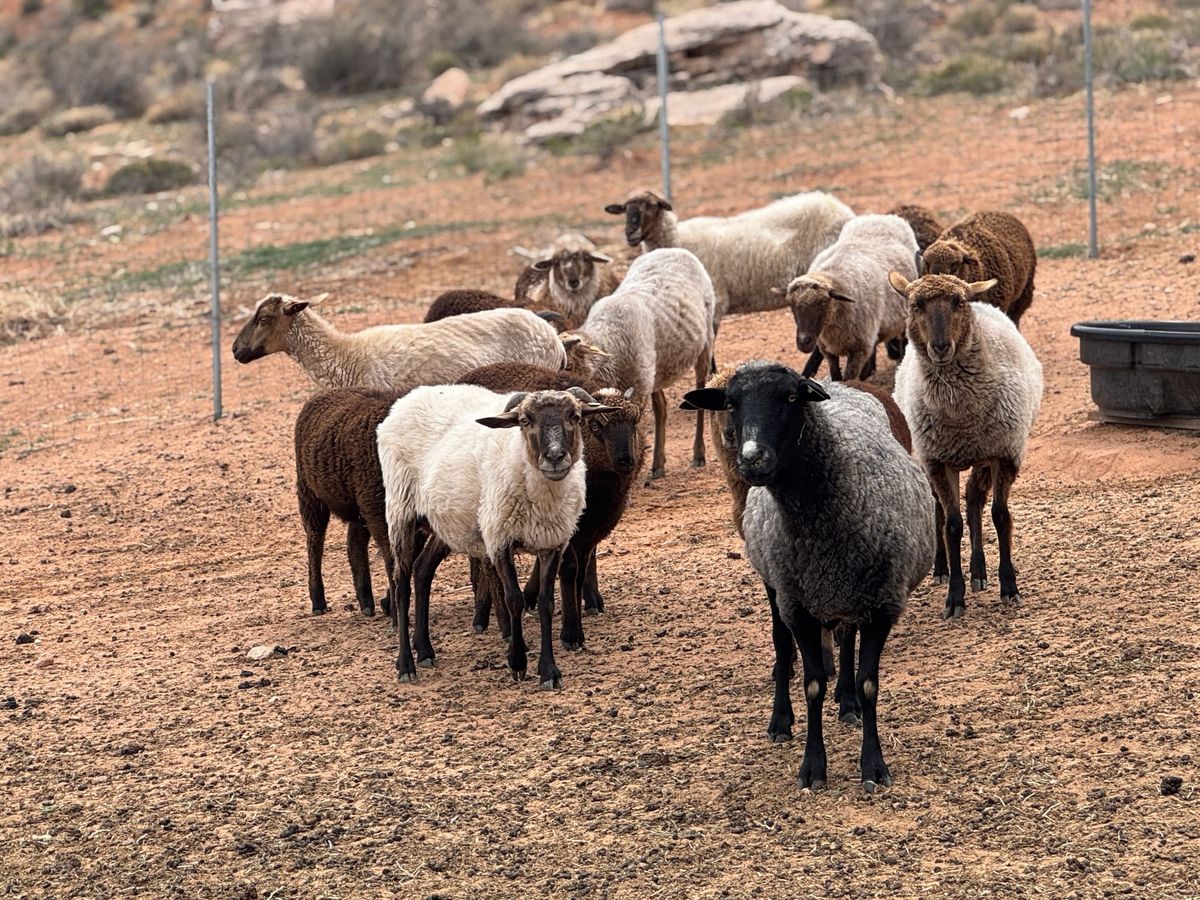
The Navajo Nation might feel like an unusual place to rendezvous with an Instagram Influencer. But during the pandemic, queer Native shepherd Nikyle Begay became a cultural educator via social media for people both inside and outside the Native Community. Their love for the Navajo-Churro sheep — Dibé dits’ozí — a rare heirloom breed, drew many people to Nikyle’s account. As a weaver with a knowledge of butchering sheep nose to tail, Nikyle navigates all aspects of the traditional relationship with this animal. But Nikyle isn’t alone; carrying on traditional lifeways has become a part of life for many members of the queer Navajo community.
“I remember one time I was cleaning out the small intestine, like really good,” Nikyle reminisced about helping their grandmother slaughter a Churro sheep. We were on a shearing job deep in the Navajo Nation, on the ranch of Richard Begay. “And my grandma, she’s very stern and just very matter-of-fact. … She just came up and whacked me on the back of the head and basically just read me for filth in Navajo about how you’re not supposed to clean it so good.”
“You take the taste out of it!” Richard confirmed, agreeing with Nikyle’s grandma.
“And also, some of the nutrients, ’cause these guys eat things that we can’t.” Historically, the partially digested greens were pulled out of a sheep’s first stomach and eaten because the digested forage could be consumed while many of the fresh desert plants cannot. Forage like grasses have high amounts of lignin and cellulose, which is tough for human gastrointestinal systems to break down. But ruminants like sheep are designed to extract nutrients from forage; the partially digested greens have their tough fibers broken down, so they were consumed by the Diné, a much-needed addition to a diet that lacked greens.
The view from Richard’s farm was astounding; we were at one of the highest points in the reservation, 7,000 feet up, a panoramic view with the Chuska mountain range in the distance. Richard lassoed a Churro ewe; the two of us lifted the compact animal onto a table easily. After some initial kicks, she settled in. Her undercoat was particularly dense and matted, the texture of a Brillo pad, and having it clipped seemed to be a relief. Richard showed me how to use the shears — cut as close to the skin as possible, smaller sections than you would imagine, and try to not leave wool behind that needs to be trimmed off — those are called second cuts and can’t be sold. When I started working on the wool on her neck, the ewe leaned into the shears and half closed her eyes. I paused to give her some deep scratches and a neck massage.